
The 2025 National Progressive Donor Survey: Key Takeaways for Nonprofits
Listening to your donors is one of the hallmarks of any successful grassroots fundraising program. We are increasingly prioritizing quantitative and qualitative research to determine what issues nonprofit and political donors care about most, how they are reacting to their donor experience, and how their giving behavior is impacted by the current social and political environment.
These are among the driving forces and questions that shaped The 2025 Mellman Group-AB Data National Progressive Donor Survey (NPDS)—the fifth time our two firms have collaborated on such a survey.
We conducted a survey of 500 direct mail donors by phone and 1,076 online donors by internet, drawn from donor lists representing five sectors within the progressive donor community: Political, International Aid & Relief, Civil and Constitutional Rights, Women’s Rights, and Environmental.
Our survey questions probed a range of topics designed to get at the heart of donor priorities and motivations with a goal of extracting insights that could drive fundraising potential, including:
- What issues concern them the most?
- Which political figures do they admire and loathe?
- How do political campaigns and elections impact their contributions relative to their support for non-profit charity or advocacy groups?
- What are their giving plans for the coming year and what giving channels are they planning to use to deliver those contributions?
We think the results are as useful as they are revealing. From this year’s NPDS emerged a distinct donor contingent that we came to describe as, “Burnt Out and Angry About the Lack of Results but Also Energized to Fight Trump.”
Donor Mindset: Burnt Out, But Still Ready to Fight
Digital co-ops are databases managed by private companies that combine donor and behavioral insights from dozens to hundreds of participating nonprofits. All of these inputs from co-op members allow the co-ops to provide modeled audiences of the people who are most likely to engage with a specific cause. It’s an idea rooted in direct mail co-ops but re-imagined for digital channels. Members contribute data, and in return, gain access to prospects who are known to be actively engaging on other email lists, donating to nonprofits, and supportive of similar causes.
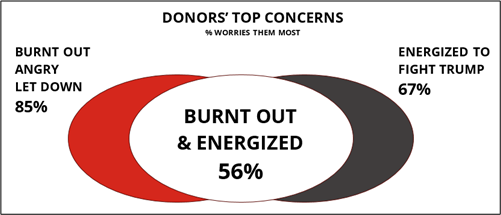
Progressive donors are navigating two strong—and somewhat conflicting—emotions: deep frustration with political leaders and progressive organizations that have seemingly failed to prevent and/or mitigate global disasters, and an urgent determination to push back against Trump’s second presidency.
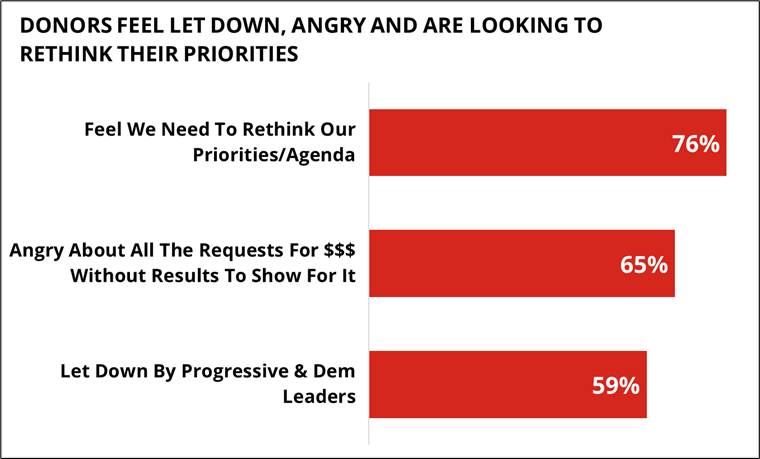
More than three-quarters of donors surveyed indicate they are dissatisfied with the organizational priorities of progressive charities and political candidates. They are angry about a lack of results but remain motivated when shown how their giving directly fuels opposition and change.
What Worries Donors Most
Overarching concerns about the Trump administration are the top motivators for progressive grassroots donors. A decisive 73% said they fear Trump’s threat to freedom and 70% worry he’ll do more damage with loyalists in place, 68% agree his fascist leanings are a real threat.
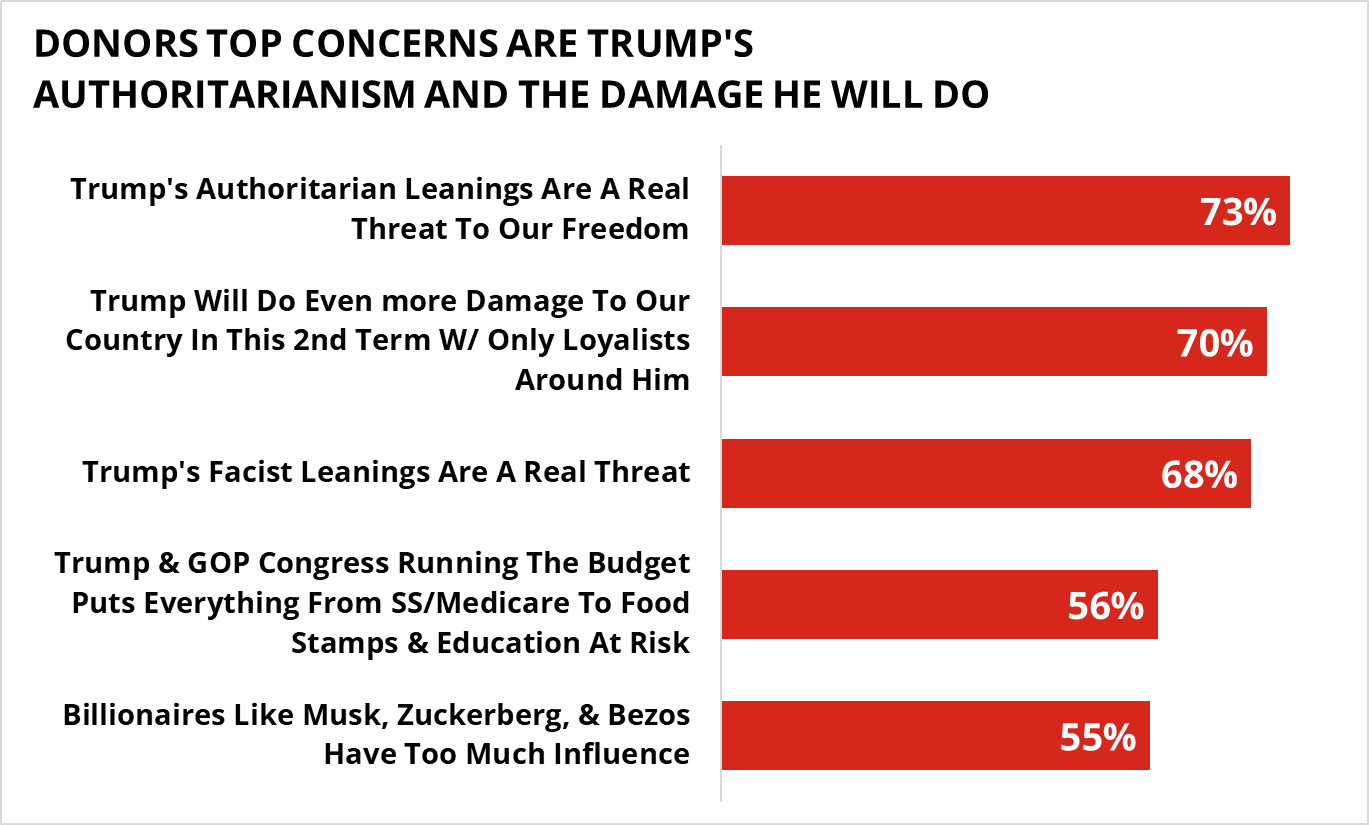
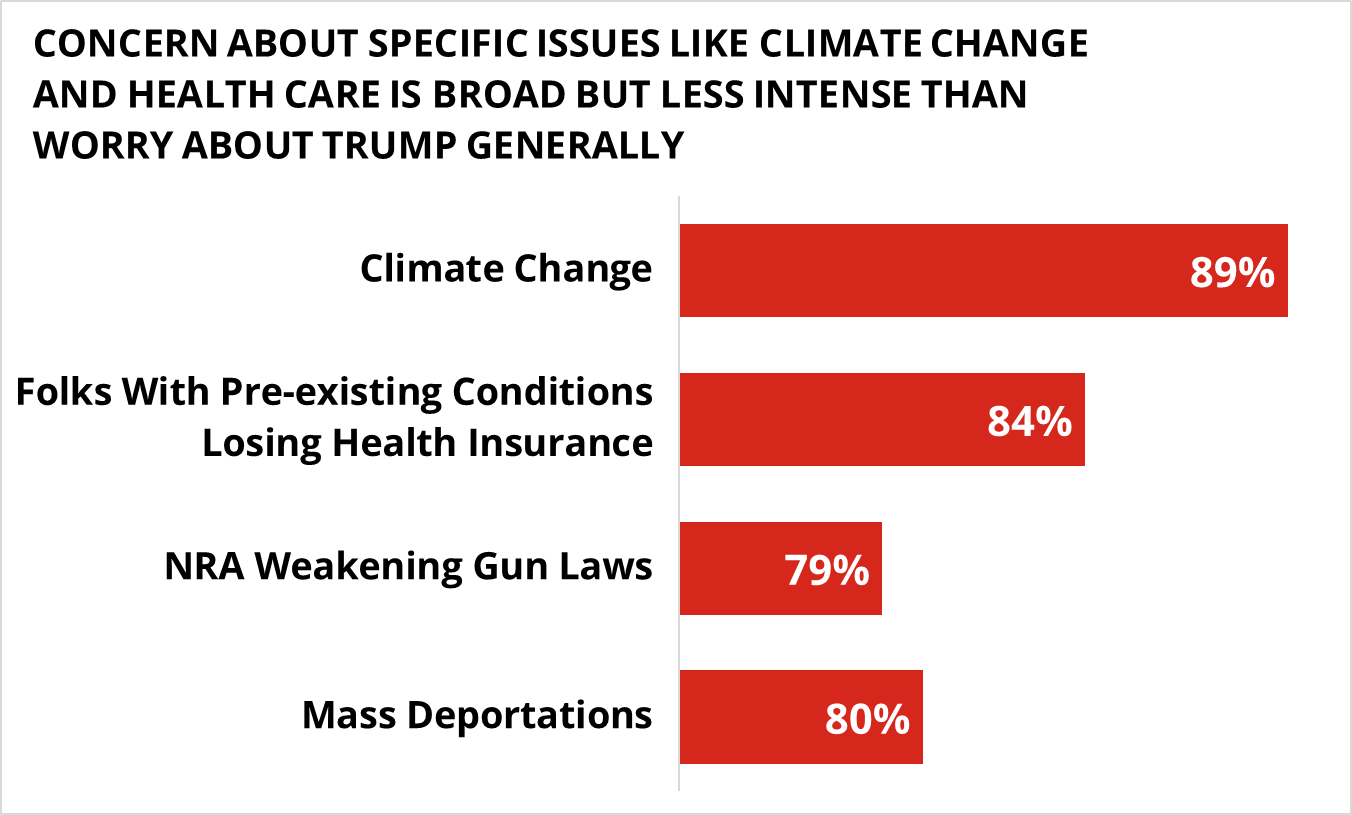
Progressive donors are also deeply concerned about issues ranging from climate change to health care and immigration to gun safety reform. An impressive 48% cite concern over RFK’s health policies, climate change and environmental protection as top concerns.
Threats to Fundraising in a New Era
In the aftermath of a second Trump election, we found that these are very different times than in 2017 when he was first elected to office. That was a moment marked by what we now call the “Trump Bump,” a galvanized donor community, re-energized and a bit terrified of what lay ahead, but committed to supporting new and old causes threatened by Donald Trump. The most significant difference today from eight years ago when we last surveyed, is that donors in the first half of 2025 felt burnt out, angry, and disappointed in how Democratic and progressive leaders and organizations responded in 2024 and continue to respond (or, more accurately, fail to respond) to the Trump threat.
These feelings directly impact donor behavior and account for the substantial rise in the number of donors planning to give less money and give to fewer organizations than in previous years. Donors tell us loud and clear that understanding the impact of their donations greatly influences their decisions to support (or not support) a candidate or charity.
Only 43% plan to increase their giving—a big drop from 67% after Trump was elected the first time. And 40% of political donors say they will give less than before. What we heard repeatedly is donor confidence in transparency has eroded—just shy of 50% feel they know where their money goes, compared to two-thirds four years ago. In the chart below, we see the evidence spelled out for us:
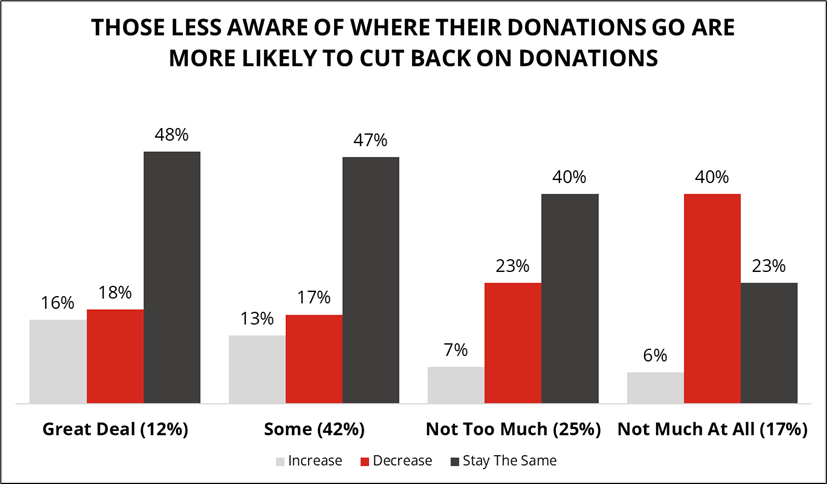
The 2025 NPDS shows us, again and again, that donors have increasingly lost confidence in the effectiveness of progressive and political organizations and leaders. Now is the time to repair and rebuild the donor relationship with a clear explanation of the organization’s priorities and how current programs and services will have a direct impact on moving the needle toward building a better world.
Donor Motivation: Evidence of Accomplishments, Transparency, and Taking on Trump
Three quarters of progressive donors surveyed say it is “very important” for progressive organizations to show specific accomplishments (78%) and “exactly” where money is being spent (73%). More than half of those say it is “absolutely essential” to do it (42% and 37%) respectively.
Even so, we found that “taking on Trump” is more important to donors than the above priorities. Tying social, political, and humanitarian issues directly to Trump’s policies (e.g., cuts to Social Security/Medicare/USAID) significantly increases concern and strengthens donor commitment.
In March, when the 2025 NPDS was still in the field, we found that 67% of respondents were “Energized to Wage a Fight Against the Trump Administration.” That percentage is now, almost certainly, higher. Every day, donors see how the decisions made by this administration take food from the mouths of kids who are hungry, dehumanize immigrants who are being rounded up and deported seemingly at random, accelerating the relentless advance of the climate crisis, and sacrificing millions of Americans who will lose their health insurance and millions more who now see a clear and present danger to the future of Medicare and Social Security. It’s time to clearly communicate how your organization is building a movement to challenge what is happening—on a daily basis—in Washington and show how action and financial support can help confront this existential threat.
The Continuing Collapse of Donor Silos
There is a lot of evidence pointing to a continuation of what we saw four years ago—the collapse of fundraising silos and an increasing number of donors moving seamlessly from one channel to the next. Results from the 2025 NPDS show 47% of mail donors like to get information from both mail and email, or email alone. Additionally, 28% of online donors like to get information from the mail or both mail and email.
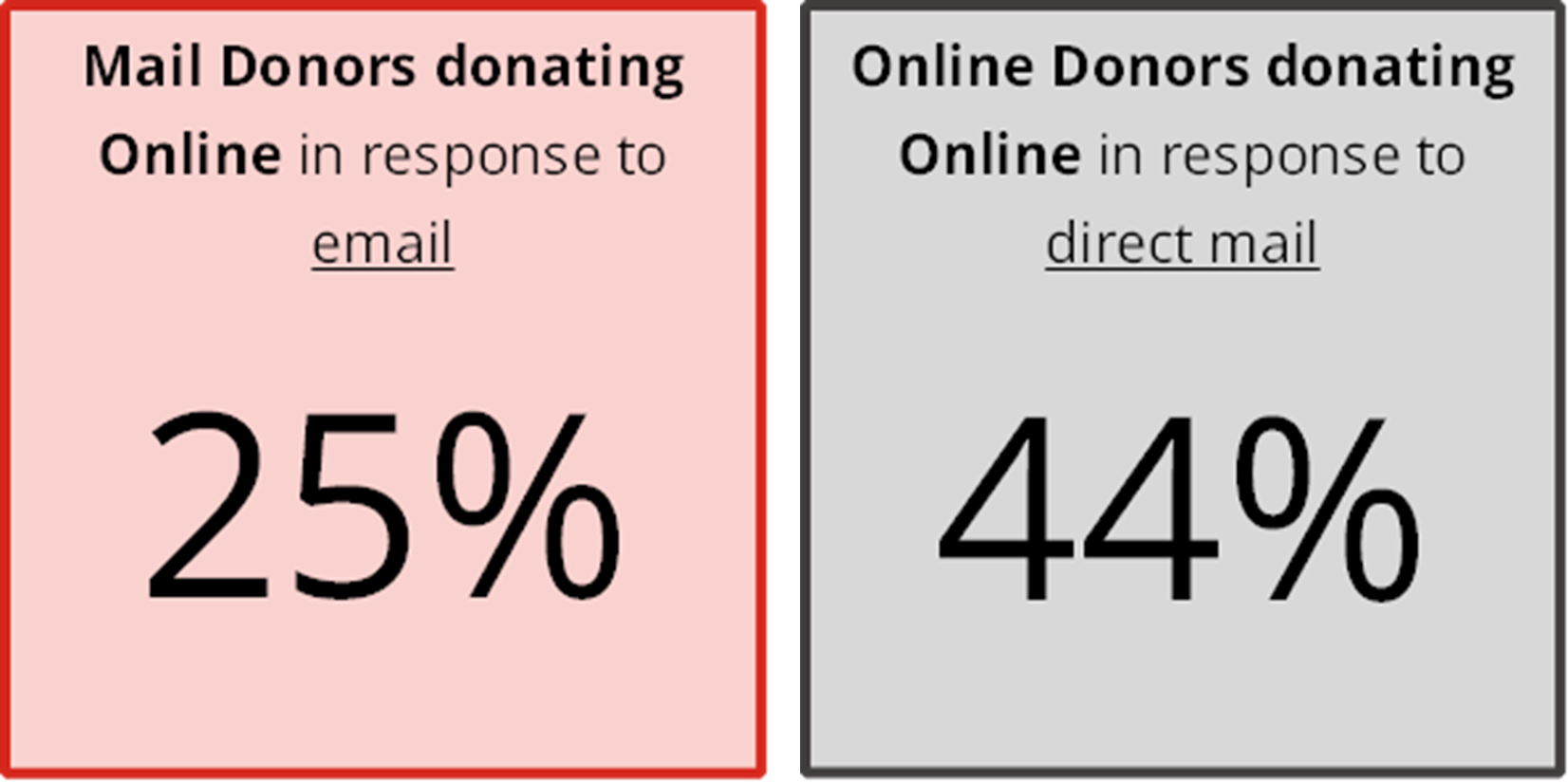
It’s critical that we follow the money to measure the true impact of cross-channel fundraising touches on giving. That means performing regular match-backs to determine how whitemail donor behavior. So, if you haven’t done it yet, we highly recommend you embrace a genuine multi-channel donor journey to enhance donor value. Success is not measured by a body count but by the number of committed, high value donors who will stay with you through thick and thin.
Direct Mail Lives On
Perhaps surprisingly, the 2025 NPDS found that online donors are slightly older than offline donors—an average age of 73 versus 71. When we first looked at demographic differences between online and offline donors 17 years ago, the average age of a direct mail donor was 69 and the average for online donors was 57. Digital consultants and pundits took this data point and used it to declare that “direct mail is dead or dying” and soon to be completely replaced by online fundraising. With online donors now officially older than their direct mail counterparts, we’re not sure what the digital pundits might say now.
Two conclusions seem clear to us: First, the similar age profile between the two categories likely reflects the fact that everyone is online now, age no longer seems to be a factor driving it, and older donors give more money than younger ones. Second, both forms of fundraising—online and offline—remain important and valuable as part of an integrated, multi-channel fundraising effort.
Key Takeaways for Maximizing Progressive Fundraising
- Be Bold: Donors want decisive, movement-oriented messaging that shows organizations are going on the offensive against the Trump administration by changing the playing field, not just “continuing the fight.” Don’t confuse their interest in new and creative approaches with a reluctance to fight.
- Get Specific: Clearly connect donations to tangible outcomes and be transparent about spending.
- Innovate: 68% want to see creative new approaches—not the same old gimmicks.
- Think Multi-Channel: Donor silos are collapsing. Direct mail and digital programs must work together as donors move seamlessly between them.
- Engage Beyond Giving: Build activist energy alongside fundraising. Donors want to be part of a movement, not just fund it.
Bottom Line
The data clearly shows that when charitable organization make the connection, explicitly and directly between Trump and the damage he is creating, donor support gets stronger. Case in point: when asked if they fear the possibility of cuts in Social Security and Medicare, donor responses in the affirmative increase by 10% (from 77% to 87%) when informed it will happen as part of a larger plan directed by Trump and his administration.
However, simply calling attention to the problem is not enough. In almost every conversation we have with donors and activists these days, it ends with “What can I do about it? Why aren’t the Democrats or the progressive organizations doing something about this?”
The short answer is this: listen to your donors and tell them who you are. Trust your donors with transparency. Give them concrete details about the potentially new, different, and creative ways you are addressing the problems of injustice, inequality, authoritarianism, human rights violations, and more this time around. Resist the urge to fall back on overused language like “we will continue the fight” and, instead, rebuild your credibility with your donors by acknowledging the fight is different now and you are up for this new challenge.
Nonprofits that embrace transparency, movement-building, and bold opposition messaging—while engaging donors across multiple channels—will be best positioned to secure and grow support in this challenging environment.
Want to receive future newsletters from us directly to your inbox? Sign up for Fundraising Forward here.